Statement of Peter Meyer & XORD Partnership
(Back to Top | AI Guide)XORD AI is proud to partner with esteemed software developer Peter Meyer to integrate his foundational astrological calculation engines into the XORD AI Astrologer platform.
The core software modules, including Planetary Aspects and Transits (PAT) 26.1, Heliocentric Planetary Aspects and Transits (HPAT) 30.0, Planets Stars Exact Aspects (PSE) 16.0, Transits for Astro-Trading (TAT) 14.0 and, Your Planetary Transits (YPT) were developed by and remain the intellectual property of Peter Meyer.
Through a formal partnership, Mr. Meyer has granted XORD AI the exclusive rights to use, distribute, and build upon these powerful tools. Our collaboration gives this legacy software a new life, combining its precision with our advanced AI to deliver unique astrological insights. This partnership ensures the continued availability and innovation of Mr. Meyer's significant contributions to the field of astrology.
The platform's user guidance is delivered through two distinct artificial intelligences. The XORD AI Astrologer focuses on interpreting the software’s output, while the AI Guide (accessible at the bottom of each page in this manual) provides supplementary help with its features. These tools are designed to be a comprehensive and self-contained system for assistance.
Please note that Mr. Meyer is not involved in day-to-day operations or support.
What the Chart Shows
(Back to Top | AI Guide)From the point of view of an ideal observer at the center of the Earth, the Sun traces out a complete circle against the background of the fixed stars during the course of a seasonal year, and it traces out the same circle every year. This circle is called the ecliptic, and it determines the ecliptic plane.
Each planet orbits the Sun in its own orbital plane, and (with the exception of Pluto) these orbital planes almost coincide with the ecl Barlow ecliptic plane. Thus it is approximately true that all the planets move in the ecliptic plane, with slight movements above and below it (somewhat larger vertical movements in the case of Pluto), so at any given time the position of a planet is approximately specified by a longitude, called the celestial longitude (a.k.a. the ecliptic longitude). Astrologers generally ignore the angle of a planet above or below the ecliptic plane, and consider only its celestial longitude.
The chart displayed by this program is not the kind of horoscope chart displayed by most Western horoscope programs. A Western natal horoscope represents a picture of the sky at the time and place of your birth. The 9 o'clock position corresponds to the eastern horizon. This is the position which is 'ascending' (in the sky) at that time and so it is called the 'ascendant'.
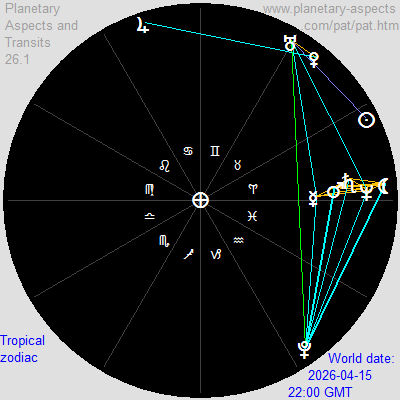
In contrast, the chart displayed by this program represents the planets on the ecliptic, as viewed from a position in space directly above the Earth. The ecliptic is divided into 360 degrees. The 3 o'clock position corresponds to zero degrees, and degrees increase anti-clockwise, so 90 degrees is at the 12 o'clock position.
Even though the chart as displayed in this program is not the same as the chart displayed in a Western horoscope, the zodiacal positions of the planets in the two charts is the same (when calculated correctly).
Aspects and Transits
(Back to Top | AI Guide)When the angular separation of two planets (that is, the difference in their longitudes) is close to 0°, 30°, 45°, 60°, 90°, 120°, 135°, 150° or 180° then the planets are said to form an aspect. These have names: conjunction (0°), square (90°), opposition (180°), etc.
When three or more planets are such that each pair of planets forms an aspect then we have what is called an aspect pattern.
Contemporary astrological practice (in which natal charts and transits are interpreted and used for prediction) employs astrological signs (Aries, Gemini, etc.) and houses (twelve of them, each divided into three decans), and proceeds to add complications such as planets ruling signs and houses, and planets being exalted, dignified, etc., according to which house they are in. Signs are classified as cardinal, fixed and mutable. Houses are said to correspond to work, relationships, etc.
This software does not include these complications, being concerned only with aspects and transits. It has two purposes: (i) to provide practicing astrologers (and those with an interest in astrology) with accurate and easily accessible data concerning world transits, natal charts, personal transits and synastry and (ii) to provide information about planetary aspects and transits so as to check the claims of Richard Tarnas in his book Cosmos and Psyche. What is needed for the latter is only an understanding of aspects and transits and some grasp of the meaning of planetary archetypes (for which see Cosmos and Psyche).
A transit occurs when an actual (that is, a moving) planet forms an aspect with a planet in the natal chart, so transits occur over a period of time. The term transit can also be used to mean an aspect between two actual planets lasting a certain period of time. The duration of a transit may be short (perhaps just hours) or long (perhaps years), and depends on the value assigned to the orb for that aspect: the larger the orb the longer the transit.
The concepts of natal chart, personal transit and world transit are basic to the use of this software. Richard Tarnas explains these concepts as follows:
The natal chart: The positions of the planets relative to the time and place of an individual's birth are regarded as bearing a significant correspondence to the person's life as a whole, reflecting the specific archetypal dynamics and relationships expressed in his or her specific psychological tendencies and biography.
Personal transits: The positions of the planets at any given time in relation to their positions at an individual's birth are regarded as bearing a significant correspondence to the specific experiences of that person at that time, reflecting a dynamic activation of the archetypal potential symbolized in the natal chart.
World transits: The positions of the planets relative to the Earth at any given time are regarded as bearing a significant correspondence to the prevailing state of the world, reflecting the state of collective archetypal dynamics visible in the specific historical and cultural conditions and events of that time.
In all three forms of correspondence, the particulars of the planetary interaction — which planets are involved and how they are geometrically aligned with each other — are considered to be the most important determining factors in understanding the corresponding human phenomena.
Midpoints
(Back to Top | AI Guide)A midpoint in astrology is a point C on the ecliptic (whether geocentric or heliocentric) which is equidistant between two other points A and B on the ecliptic at which planets are present. Equidistant means an equal angular distance from those two planets, whether it is measured the short way around the ecliptic or the long way. Thus there are always exactly two midpoints between two planets.
A mathematical "midpoint" is of interest astrologically only if there is a third planet present at that point (or close to it), so that (in theory) the influences of all three planets are combined. When there is a midpoint there may or may not be an aspect (for example, semisextile) between the planets at A and C (and thus those at C and B). If there is, then there is also an aspect between the planets A and B (in this example, sextile). Such a midpoint is designated as A-C-B.
In the chart at right there are two midpoints, Venus-Mercury-Uranus and Saturn-Mars-Pluto.
Midpoints are considered (by many astrologers) to be significant whether or not there is an aspect present between some pair of planets among the three planets themselves.
Use of the Software
(Back to Top | AI Guide)There are four types of calculations which can be made:
- World transits for a given date and time
- The natal chart for a person's birth date
- Personal transits for a person's birth date and a given world date
- Synastry between two people's birth dates
Each of these can be calculated either using a tropical zodiac or a sidereal zodiac (see more on these below).
When a date is specified (whether world date or birth date) a time may optionally also be specified. If no time is given then it defaults to 12:00. The time may also be qualified by reference to a timezone. If no timezone is given then it defaults to the local timezone (the timezone of the computer being used). So, for example, if a person is known to have been born at 3 p.m. in Rome, Italy, then the time should be specified as 15:00 GMT+1:00. The configuration panel allows inclusion or exclusion of U.S. timezone abbreviations such as PST and PDT.
The range of dates which may be entered is from January 1, 1 CE, through December 31, 2799 CE. The longitudes of Uranus, Neptune, Pluto and the Moon cannot be calculated by this software for dates prior to January 1, 1600 CE, so for such dates these planets will not appear in the table or in the graphical display. The longitudes of Pluto and the Moon cannot be calculated by this software for dates after December 31, 2099 CE.
Clicking on the 'Now' button sets the world date to the current date, time and timezone, as read from your computer.
To calculate world transits for a particular date, to get a natal chart for a person's birthday, to get the personal transits for a particular person at a particular world date or to calculate the synastry for two people, enter the appropriate dates and select the output desired.
When changing dates and times by means of the drop-down menus you may need to click on the 'Compute' button to get the result in tabular or graphical form. Do this especially if the 'Display chart' (which changes to 'Display table') button is not visible. You can easily switch back and forth between the tabular display and the graphical display using this button.
The results are displayed in a table, and can also be displayed graphically.
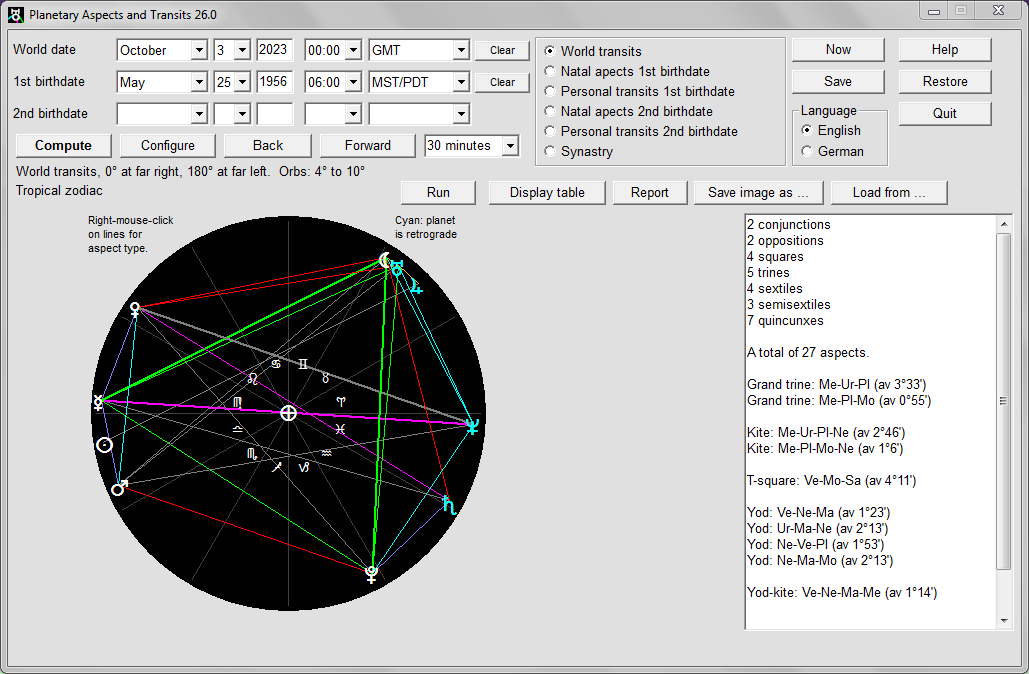
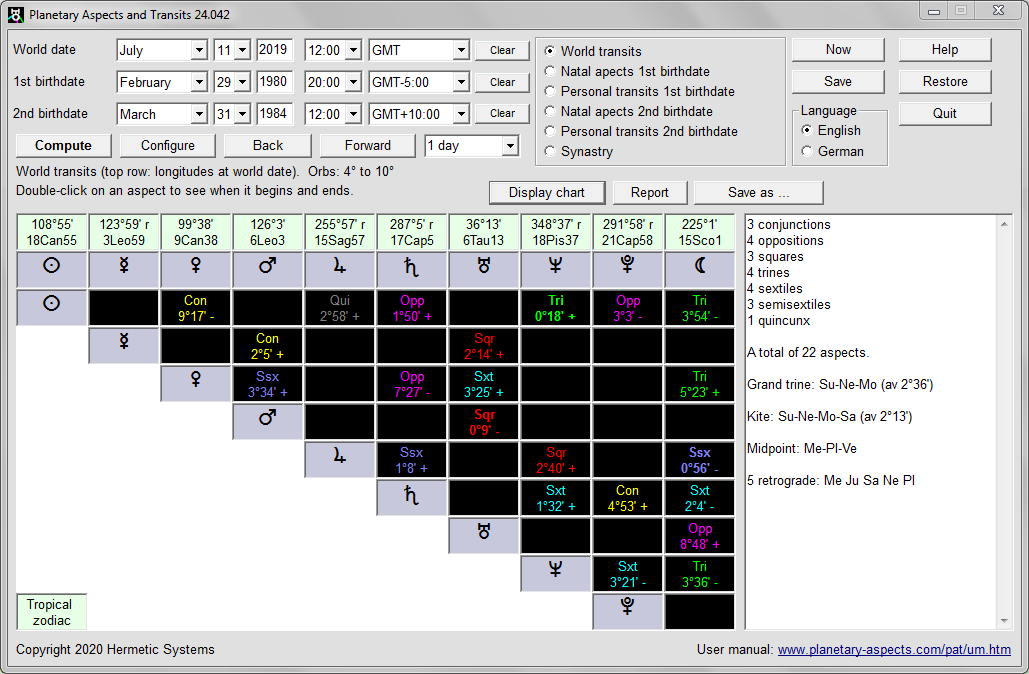
An 'r' following the longitude of a planet indicates that it is retrograde (that is, apparently moving backwards). It is fairly common for planets to be retrograde; this is due to the relative motions of the planets and the Earth.
The angle values in the table give the difference in degrees and minutes from the exact value of an aspect. For example, if Mars and Venus are shown as Sqr 3° 0' that means that the difference in their longitudes is 3° away from the exact value for a square aspect, namely, 90°, so that difference is between 87° and 93°. A '+' following an angle value means that the aspect is increasing at the date and time shown, and a '-' means that it is decreasing.
Aspect patterns with three or four planets have an "av." value shown. Each aspect in the aspect pattern differs from an exact aspect by a certain amount, and the "av." value is the average of these differences. For example, a Jupiter-Mercury-Moon T-square may be composed of a Jupiter-Moon opposition with exactness of 0°37', a Jupiter-Mercury square, 1°43', and a Mercury-Moon square, 2°20', with average difference-from-exact of 1°34'. By moving forward and back by a day or a half-hour one can find the date (and time) at which the average value is a minimum and thus the aspect pattern itself is most exact.
With world transits, double-click on an aspect (in the table) to display the duration of the transit.
With a world transit, answering 'Yes' to the question brings up a report such as the one below (which can also be accessed via the 'Report' button):
The phrase 'Both zodiacs (tropical and sidereal)' does not mean that the results shown are somehow a "blend" of the two systems (as one user thought). Rather it means that the results are the same regardless of whether the tropical zodiac or the sidereal zodiac is being used.
The same kind of report is available for personal transits by clicking on the 'Report' button. For personal transits, however, the results do depend on which zodiac is selected.
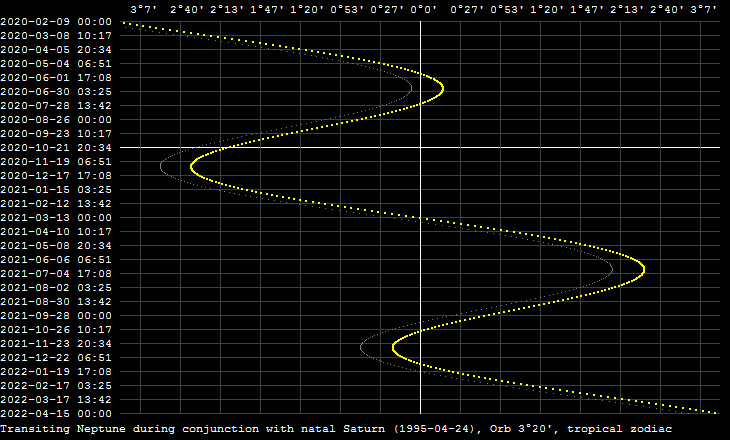
With personal transits, double-clicking on an aspect (in the tabular display) displays not the report but rather a graphic image of the duration of the transit, showing the positions of the transiting planet relative to the natal planet.
The middle part of the graph shows that Uranus was retrograde from approximately November 24, 1958, to April 22, 1959. (Actually, as can be found by inspection of tabular values in this program, it was retrograde from November 22, 1958, to April 19, 1959.)
The colored graph shows the difference from exact conjunction when the tropical zodiac is used, and the gray line shows the difference when the sidereal zodiac is used. The selection of zodiac in the Configuration panel determines which graph is colored (namely, the graph for the selected zodiac) and which is gray. Right-mouse-click on a (non-black) pixel shows the corresponding date and time, as shown at right.
For aspects other than conjunction, the graphs show the difference when the longitude of the transiting planet is offset by the appropriate amount (e.g., 90° for squares and 120° for trines).
These graphs can be saved as PNG files by clicking on the 'Save image as ...' button.
The 'Forward' and 'Back' buttons move forward or back by the selected period: 30 minutes, 1 day, 1 week, 1 month or 1 year. When the chart (the graphical image of the location of the planets) is displayed, a 'Run' button appears. This is used to run the graphical display forward by 1 day, 1 month or 1 year until stopped.
If world transits are displayed then the 'Run' button allows you to search for a particular aspect pattern (stepping by 1 day, 1 week, etc.). You can also tell it to look for the simultaneous occurrence of two or more of the selected aspect pattern.
The state of the program can be saved via the 'Save as ...' button. This is useful for saving a particular person's birth date (so the file should be named after them) and for saving a particular pair of birth dates (again with the file named appropriately). A file so saved can then be loaded again later to restore the program state. Program state files always have extension pat.
When the graphical image is displayed the 'Save image as ...' button allows you to save the image to a PNG file. You can choose between a black background (as onscreen) or a white background by means of the 'Save graphic ...' checkbox in the configuration panel (see below). A black background provides better contrast for an image displayed in a web page, so a white background is recommended only if you wish to print the image (so as to save on ink).
Same-Planet Aspects
(Back to Top | AI Guide)A same-planet aspect is an aspect between two planets with the same name. There are two kinds:
- An aspect between a transiting planet and its corresponding natal planet.
- An aspect between planets of the same name in a synastry chart.
Such aspects are more significant than other aspects simply because the planets are the same.
Aspect Pattern Search
(Back to Top | AI Guide)This software makes it easy to search for aspect patterns and for a certain number of aspect patterns of one kind occurring simultaneously.
The search function is available only for world transits, not for personal transits, and you can only search forward, not back.
To use the search function:
- Select the world date (and time) at which you wish to begin the search.
- If the table is displayed then click on "Display chart".
- Set the step size for the search ("1 day" is recommended).
- Click on "Run". A window then opens which allows you to "Run until stopped or until finding a ..."
- Select the aspect pattern you want to search for (e.g. a grand trine).
- If you want to search for two or more such patterns occurring simultaneously then check the "Find at least" box and specify the number.
- Check the "Run quickly" box.
- Click on the "Run" button.
The program then calculates a series of charts according to the step size and stops if and when it finds the specified number of aspect patterns of the specified kind.
Configuration
(Back to Top | AI Guide)Tropical and Sidereal Zodiacs
There are two zodiacs in use by astrologers. Vedic (Indian) astrologers use a sidereal zodiac whereas most Western astrologers use a tropical zodiac. The difference between them lies in the reference direction used as the zero for specifying planetary longitudes. The Vedic system uses the direction of a constant point on the ecliptic, a point in the constellation of Aries, so it is known as zero degrees Aries. In the 2nd century CE the Greek astrologer Claudius Ptolemy took zero degrees Aries to be the direction of a line from the Earth through the Sun at the moment of the vernal equinox. Due to what is called the precession of the equinoxes this direction is now no longer the same as the direction used by Vedic astrologers. Over the centuries the difference has increased, so that now (2010) the difference between them is about 24°. Consequently the position with respect to zero degrees Aries of a planet according to the tropical zodiac differs by about 24° from its position according to the sidereal zodiac, with the result that often planets are located in different astrological signs in the two zodiacs. This has given rise to debate among Western astrologers as to which zodiac is preferable. This software allows you to use whichever zodiac you prefer.
Orbs
When two planets form an aspect, that aspect may be exact or it may differ from exactness by some number of degrees. The number of degrees which is acceptable is called the orb. The orb affects the number of aspects (the larger the orb the more aspects).
Orbs for world transits and natal aspects can be set for each of the seven aspects as shown at right; the values can range from 0° to 15°. When an orb is set to 0° that aspect will not appear in the tabular or graphical output. This allows you to exclude aspects from the table and the image which may not be relevant. When the orb for an aspect is set to 0° that aspect will not appear in the aspect counts nor will any aspect pattern which includes that aspect.
Orbs for personal transits are specified as some proportion of the orbs for world transits; this can range from 1 to 1/5. These orbs apply equally to all planets. Synastry orbs can be set in the same way, independently of the orbs for personal transits.
The midpoint orb is set separately. Any of eight values can be selected, from 0° 5' to 3°. The larger the midpoint orb, of course, the more midpoints will appear. To avoid an excessive number, the midpoint orb should normally be set to 1° or less.
When the 'Don't show aspects including inner planets' checkbox is checked, then only aspects involving any two of Jupiter, Saturn, Uranus, Neptune and Pluto are displayed in the chart.
Changes to the settings do not take effect until you click on the 'Use settings' button. You can cancel any changed settings by clicking on the 'Cancel' button.
When the 'Keep selected zodiac' checkbox is checked, the current zodiac setting is not changed by the 'Reset to default' button.
Exactness of Aspect
You can also specify when an aspect is shown as "close" by specifying that boldface (in the table) or a thick line (in the graphical display) should be used when the separation is (a) less than either one degree or (b) less than a certain proportion of the orb (the proportion can be selected from nine values in the range 1/20 to 1/2).
The checkboxes for color and boldface apply also to the graphical display. If the boldface checkbox is checked then lines joining planets in the graphical display are thick if the separation is less than 1° or less than the specified proportion of the orb, otherwise they are thin.
Transiting Moon
In natal charts and synastry the natal Moon (Moon position at time of birth) has a fixed position. In charts for personal transits the natal Moon has also, but there is also a transiting Moon (Moon position at a specified time). For a chart of personal transits, you may choose to include the transiting Moon or to exclude it. This choice does not affect the other types of chart.